
The Outdoor Advantage: What Research Says About Outside Play and Children's Wellbeing
Published by Wellbeing Instruments | Wellbeing Research Series
Something is happening to the way children play.
Over the past two decades, the amount of time children spend playing outdoors has declined significantly, replaced by sedentary indoor activity and screen time. Researchers have tracked this shift with growing concern, noting that it has coincided with a measurable rise in childhood anxiety, emotional dysregulation, and behavioural difficulties (Gray et al., 2023; Haidt, 2024).
The evidence connecting outdoor play to children’s wellbeing is substantial, and it has direct implications for how schools think about their outdoor environments. This article examines what the research tells us, and what it means for the design of school spaces.
What Outdoor Play Does to the Brain
When children play outside, something changes at a physiological level. Research consistently points to reductions in the stress hormone cortisol as one of the most measurable effects of outdoor and nature-based activity.
A 2018 meta-analysis of 143 observational and interventional studies found that exposure to green space was significantly associated with decreased salivary cortisol levels, a direct and measurable indicator of reduced physiological stress (Twohig-Bennett & Jones, 2018). Cortisol is not simply a stress marker: chronically elevated cortisol during childhood has been linked to impaired learning, reduced immune function, and long-term susceptibility to stress-related illness (Dettweiler et al., 2017).
A 2024 systematic review published in Educational Psychology Review found that school-led nature interventions, including green schoolyards, school gardens, and outdoor learning, produced measurable improvements in positive affect, stress reduction, and social wellbeing among children and adolescents. Notably, the review found that positive affect increased most significantly in students with high emotional difficulties, suggesting that the children who stand to benefit most from outdoor environments are precisely those who are currently struggling (Dettweiler et al., as cited in Vlieger et al., 2024).
Attention Restoration: Why Going Outside Resets Children
One of the most well-established frameworks for understanding the relationship between nature and wellbeing is Attention Restoration Theory (ART), developed by researchers Kaplan and Kaplan in the 1990s and since supported by a substantial body of empirical evidence.
The theory proposes that directed attention, the kind required for sustained classroom learning, depletes over time, leading to fatigue, irritability, and impulsive behaviour. Natural environments, by contrast, engage what researchers call involuntary attention: the effortless, restorative kind of attention that does not deplete cognitive resources but instead allows them to recover (Kaplan, 1995).
This has clear implications for the school day. Recess and lunch breaks are not interruptions to learning; they are neurologically necessary recovery periods. And the quality of the outdoor environment during those breaks determines how much restoration actually occurs.
A prospective longitudinal study by Dettweiler et al. (2017) measured salivary cortisol across a full school year in children taught one day per week outdoors in a forest, compared to those in standard indoor classrooms. Children in the outdoor group showed a significantly greater decline in cortisol across the school day, a finding that held even after controlling for differences in physical activity. The researchers concluded that the outdoor environment itself, not simply the exercise, was responsible for the stress-buffering effect.
The Social Dimension: How Outdoor Spaces Build Connection
The wellbeing benefits of outdoor play are not only physiological. Outdoor environments also serve as the primary setting in which children develop social skills, build peer relationships, and practise the cooperative behaviours that underpin school belonging.
Research published in Frontiers in Psychology found that children demonstrated higher levels of cooperative and associative play on school playgrounds than in community settings, suggesting that the school outdoor environment plays a particular role in supporting social development (Amholt et al., 2021). A literature review conducted by Child Trends found that playgrounds support social-emotional development through cooperative play, turn-taking, and peer interaction, with these outcomes compounding over time into stronger school belonging and emotional resilience (Child Trends, 2025).
For neurodivergent children, the design of the outdoor space matters even more. Research published in Children and Youth Services Review in 2025 found that neurodivergent children often struggle to initiate or sustain peer interactions, and that playground features specifically designed to invite communication and cooperation play a critical role in supporting their social inclusion (Kelly et al., 2025). The study called for school playgrounds to be reimagined as ‘inclusive ecosystems that nurture self-regulation, social connection, and wellbeing.’

The Problem With Traditional Playground Design
Despite the evidence for outdoor play’s benefits, there is a gap between what research recommends and what most school playgrounds currently provide.
A 2024 scoping review of playground research found that the health benefits of playgrounds remain underutilised, partly because many playground designs prioritise physical activity equipment such as climbing frames, slides, and swings without considering the cognitive, emotional, and sensory needs of all children (Schipperijn et al., 2024). For children who do not connect with high-activity physical play, including children with additional needs, sensory sensitivities, or anxiety, the traditional playground can be an exclusionary rather than restorative environment.
A 2023 study examining peer interaction in playground settings found that children spent the majority of their time in solo play, with peer interaction occurring only in spaces where children naturally paused and engaged together (Elevating Children’s Play Experience, Sustainability, 2023). This finding points to a clear design principle: the most socially generative outdoor spaces are not those that demand active participation, but those that create natural gathering points, places where children slow down, linger, and connect.
What This Means for School Outdoor Spaces
The convergence of this research leads to a clear principle for school outdoor design: children need outdoor spaces that are not only physically active but also sensory-rich, socially inviting, and accessible to children with a wide range of needs and abilities.
The evidence suggests that the most effective outdoor wellbeing spaces will:
Support physiological restoration by providing exposure to natural settings and sensory engagement that activates the parasympathetic nervous system and reduces cortisol.
Invite social connection through features that create natural gathering points and lower the barrier to peer interaction, particularly for children who find unstructured social situations difficult.
Be accessible to all children, including those with additional needs, sensory sensitivities, or physical differences, for whom traditional play equipment may offer little.
Offer open-ended engagement so that rather than prescribing a specific activity, the space allows children to engage on their own terms, at their own pace.
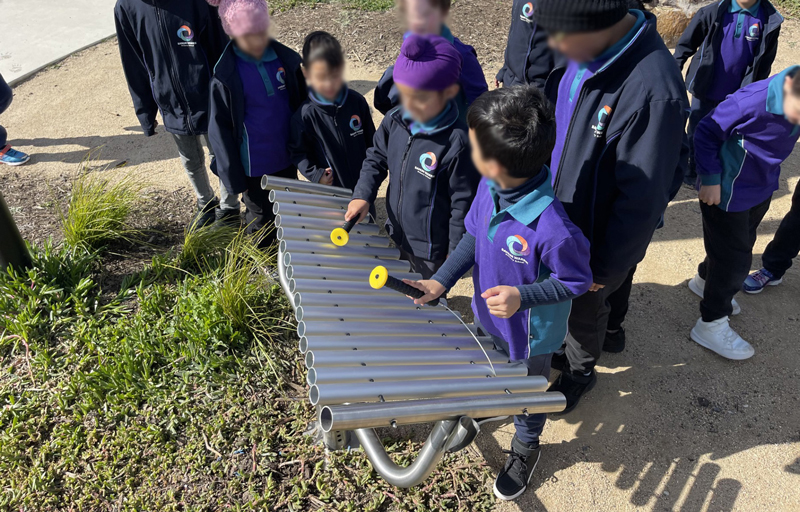
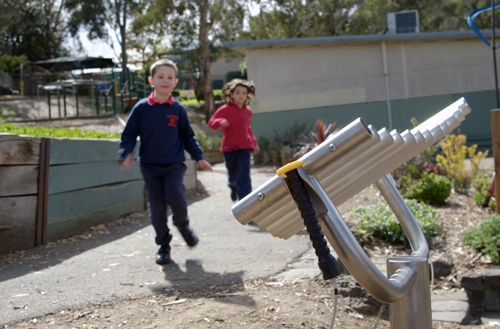
Outdoor musical instruments address each of these criteria. They provide a sensory-rich, rhythmically engaging activity that research suggests supports emotional regulation (see our previous article on music and self-regulation). They create natural gathering points without demanding competitive participation. They are accessible regardless of physical ability, verbal communication, or social confidence. And they are open-ended, with no wrong way to play.
Conclusion
The research is consistent: outdoor play is not supplementary to children’s wellbeing; it is foundational to it. As schools look to build more inclusive, restorative, and effective learning environments, the outdoor space deserves the same deliberate design thinking applied to any other aspect of the school.
The question is not whether outdoor play matters. The question is whether the outdoor environment schools provide is actually doing the work it could be doing for every child who steps outside.
References
Amholt, T. T., et al. (2021). How do the children play? The influence of playground type on children’s play styles. Frontiers in Psychology, 12, 703940. https://doi.org/10.3389/fpsyg.2021.703940
Child Trends. (2025). Playgrounds support children’s social-emotional health. https://www.childtrends.org/publications/playgrounds-support-childrens-social-emotional-health
Dettweiler, U., et al. (2017). Stress in school: Some empirical hints on the circadian cortisol rhythm of children in outdoor and indoor classes. International Journal of Environmental Research and Public Health, 14(5), 475.
Kelly, S., Kerr, J., Rieger, J., & Flanders Cushing, D. (2025). Let’s play: Co-designing inclusive school playgrounds with neurodivergent children. Children and Youth Services Review. https://doi.org/10.1016/j.childyouth.2025.00059
Gray, P., et al. (2023). Decline in independent activity as a cause of decline in children’s mental wellbeing. Journal of Pediatrics.
Gray, T., et al. (2025). Risky outdoor play and adventure education in nature for child and adolescent wellbeing: A scoping review. Behavioral Sciences, 16(1), 5.
Haidt, J. (2024). The Anxious Generation. Penguin Press.
Kaplan, R., & Kaplan, S. (1995). The Experience of Nature: A Psychological Perspective. Cambridge University Press.
Lee, H., et al. (2024). The role of timing and amount of outdoor play in emotional dysregulation in preschool children. Child: Care, Health and Development. https://doi.org/10.1111/cch.70020
Schipperijn, J., et al. (2024). The role of playgrounds in promoting children’s health: A scoping review. International Journal of Behavioral Nutrition and Physical Activity, 21, 74.
Twohig-Bennett, C., & Jones, A. (2018). The health benefits of the great outdoors: A systematic review and meta-analysis of greenspace exposure and health outcomes. Environmental Research, 166, 628-637.
Vlieger, N., et al. (2024). Effects of school-led greenspace interventions on mental, physical and social wellbeing in children and adolescents: A systematic review. Educational Psychology Review. https://doi.org/10.1007/s10648-024-09963-1
Wellbeing Instruments designs and supplies permanent outdoor musical instruments for schools, early learning centres, and community spaces across Australia. Our instruments are certified to AS 4685 Australian Playground Equipment Standards and developed in collaboration with occupational therapists.