
The Missing Middle: Understanding the Gap Between Mainstream and Specialist Education
Published by Wellbeing Instruments | Wellbeing Research Series
A recent Herald Sun investigation brought renewed attention to a conversation that parents, educators, and advocates across Victoria have been navigating for years. Neurodivergent students, those with autism, ADHD, anxiety, sensory processing differences, and related conditions, are increasingly falling into a gap between mainstream and specialist education. Too complex for standard classroom support in some areas, yet not meeting the threshold for specialist school placement, these children are what policy researchers and mental health advocates have come to call the ‘missing middle.’
The term is not new. Researchers have used it for years to describe children and young people whose needs are real and significant but who sit outside the most intensive tiers of available support (Menssink et al., 2024). What is new is the growing urgency of the conversation, and the scale of what the data is now revealing.
The Scale of the Challenge
In 2025, Children and Young People with Disability Australia (CYDA) released survey findings that reflect how much further the sector still needs to travel. Three in four students with disability reported being bullied in 2024, while 72 percent were excluded from school activities or events. These figures represent an increase from a similar CYDA survey conducted in 2022, when 70 percent reported bullying and 65 percent experienced exclusion (CYDA, 2025).
Research published in the Journal of Psychiatric and Mental Health Nursing in 2024 explored the experiences of Australian parents of autistic students, many of whom described navigating a stressful and complex path to finding appropriate support for their children (Tanner et al., 2024). The research highlights not a failure of will on the part of schools, but a systemic gap between what neurodivergent students need and what the current education framework is resourced to provide.
The Victorian parliament has also heard these concerns raised directly. In October 2024, a parliamentary adjournment speech noted that many Victorian schools are still working with behavioural frameworks that predate our current understanding of neurodiversity, and called for investment in neurodiversity-affirming professional development across the state (Puglielli, Victorian Hansard, 2024).
The Playground as a Pressure Point
For many neurodivergent students, the challenges of the school day do not begin in the classroom. They begin outside it.
Research from the University of Washington found that for children with autism, the playground can be the most difficult time of the school day. The spontaneous, high-stimulus, socially complex nature of traditional recess environments creates significant barriers to participation, and children with autism spend substantially more time alone during recess than their neurotypical peers (Gilmore & Locke, 2019).
A 2025 Australian study published in Children and Youth Services Review found that neurodivergent children face both environmental and personal barriers on school playgrounds, including overwhelming noise, poor spatial design, and unmet sensory needs. When those environments do not support self-regulation, children can find it difficult to thrive and engage meaningfully, and risk social exclusion and loneliness over time (Kelly et al., 2025).
Research on the effects of social isolation in children with neurodevelopmental disabilities has found that exclusion from peer interaction is not simply an emotional difficulty in the moment. It can limit a child’s opportunity to develop social understanding, delay learning, and increase the risk of disengagement from school over time (Guralnick et al., 2020).
The playground is a significant part of the school day. For children in the missing middle, it represents both a challenge and an opportunity.
Where Traditional Playground Design Has Limits
Most school playgrounds were designed around a particular vision of childhood play: active, competitive, physical, and rule-based. That vision serves many children well. For the estimated 15 to 20 percent of children who are neurodivergent, however, it can leave important needs unmet (Doyle, 2020).
Research examining playground experiences for neurodivergent children has identified a consistent pattern: environments that prioritise high-activity, competitive physical play can inadvertently create barriers for children who process sensory input differently, find unstructured social situations difficult, or become overwhelmed in chaotic environments (Kelly et al., 2025).
Between 5 and 15 percent of children have a sensory processing disorder, meaning they may experience significant sensitivity or under-responsivity to sound, movement, touch, and visual stimuli (Hassell Studio, 2024). For these children, a traditional playground at full intensity is not always a restorative experience.
A 2025 research study involving co-designed inclusive playgrounds found that neurodivergent children identified four key priorities for playground spaces: sensory engagement, social connection, appropriate challenge, and access to nature (Kelly et al., 2025). These are not niche requirements. They are the foundations of what makes outdoor play meaningful and accessible for a broad range of children.

What More Inclusive Outdoor Spaces Can Offer
The encouraging finding from the research is that creating more inclusive outdoor environments does not require dismantling what already exists. It involves adding features that give a wider range of children a genuine point of entry into outdoor play.
Research points to several design elements that make a meaningful difference for neurodivergent children. Quieter, lower-stimulus zones offer an alternative to the intensity of the main playground. Sensory-rich features provide predictable, regulated engagement that supports self-regulation. Features that enable parallel play, where a child can be near others without the immediate pressure of direct social interaction, support connection at a comfortable pace. And open-ended activities, those without prescribed rules, competitive outcomes, or required levels of competence, lower the barrier to participation for children who find structured play difficult (Kelly et al., 2025).
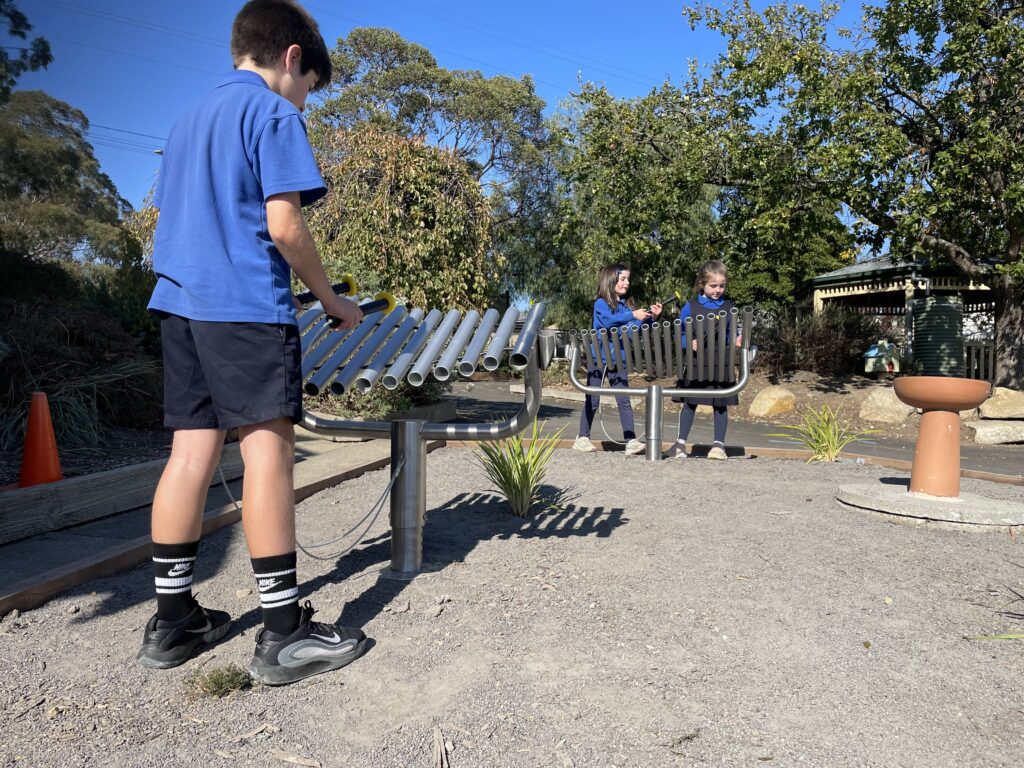
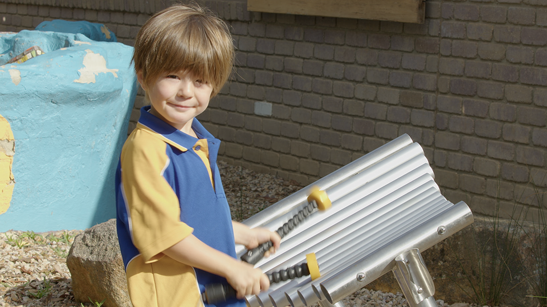
Outdoor musical instruments reflect many of these principles. They are sensory-rich without being sensory-overwhelming. They require no verbal communication, no competitive skill, and no rule comprehension to engage with. They create a natural gathering point without demanding direct interaction. They are genuinely open-ended, with no wrong note, no losing, and no prerequisite ability to participate.
For a child in the missing middle, who may find the noise of the main playground difficult to manage and who finds it hard to enter established peer groups during unstructured time, an outdoor musical instrument can offer something meaningful: a space where participation feels accessible and belonging feels possible.
A Practical Step Within a Larger Conversation
Victorian schools are managing real and growing complexity. Demand for disability support funding has increased significantly, specialist school places are limited, and teachers are supporting increasingly diverse learning needs while working within the boundaries of available resources and training (Victorian Department of Education, 2025).
The Herald Sun conversation, and the broader policy discussion it reflects, is calling for systemic change. That change is necessary and important. But while those conversations continue, outdoor environments represent something schools can act on now, within existing budgets, and with measurable benefit for students who need it most.
Thoughtful outdoor design is not a solution to the structural challenges of the missing middle. But it is a meaningful contribution to the kind of school environment where more children feel they belong. And for a neurodivergent child navigating a system that was not always designed with them in mind, that sense of belonging matters more than it might appear.
References
Children and Young People with Disability Australia (CYDA). (2025). Three in four disabled students are bullied or excluded at school and it is getting worse. https://cyda.org.au/three-in-four-disabled-students-are-bullied-or-excluded-at-school-and-its-getting-worse-new-survey-reveals/
Doyle, N. (2020). Neurodiversity at work: A biopsychosocial model and the impact on working adults. British Medical Bulletin, 135(1), 108-125.
Gilmore, R., & Locke, J. (2019). Playground study: Making recess more inclusive for kids with autism. Children’s Health Council. https://www.chconline.org/resourcelibrary/playground-study-making-recess-more-inclusive-for-kids-with-autism/
Guralnick, M. J., et al. (2020). Effects of social isolation and loneliness in children with neurodevelopmental disabilities: A scoping review. International Journal of Environmental Research and Public Health, 17(23), 8804. https://doi.org/10.3390/ijerph17238804
Hassell Studio. (2024). Designing for the divergent mind. https://www.hassellstudio.com/conversation/designing-for-the-divergent-mind
Kelly, S., Kerr, J., Rieger, J., & Flanders Cushing, D. (2025). Let’s play: Co-designing inclusive school playgrounds with neurodivergent children. Children and Youth Services Review. https://doi.org/10.1016/j.childyouth.2025.00059
Menssink, J. M., et al. (2024). The missing middle service gap: Obtaining a consensus definition of the missing middle in youth mental health. Australian and New Zealand Journal of Psychiatry. https://doi.org/10.1177/00048674241299221
Puglielli, A. (2024, October 16). Inclusive education [Adjournment speech]. Victorian Hansard. Parliament of Victoria. https://parliament.vic.gov.au/parliamentary-activity/hansard/hansard-details/HANSARD-974425065-28399
Tanner, K., et al. (2024). When the education system and autism collide: An Australian qualitative study exploring school exclusion and the impact on parent mental health. Journal of Psychiatric and Mental Health Nursing. https://doi.org/10.1080/01612840.2024.2328251
Victorian Department of Education. (2025). Disability Inclusion Progress 2025. https://www.education.vic.gov.au/Documents/Disability-Inclusion-Progress-2025.pdf
Wellbeing Instruments designs and supplies permanent outdoor musical instruments for schools, early learning centres, and community spaces across Australia. Our instruments are certified to AS 4685 Australian Playground Equipment Standards and developed in collaboration with occupational therapists.