
Why Music Helps Children Regulate: The Science Behind the Sound
Published by Wellbeing Instruments | Wellbeing Research Series
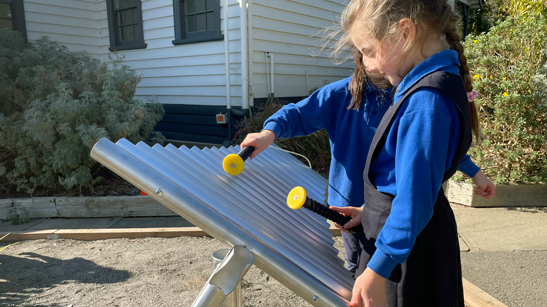
When a child sits down at an outdoor instrument during recess and begins to play — slowly at first, then with more focus — something is happening beyond simple play. Researchers have spent decades investigating what that something is, and the findings have significant implications for how schools design their outdoor spaces.
The evidence points clearly in one direction: music-making is one of the most effective tools we have for supporting children’s self-regulation.
What Is Self-Regulation, and Why Does It Matter?
Self-regulation refers to a child’s ability to manage their emotional responses, sustain attention, control impulses, and adapt their behaviour to meet the demands of a given situation (Schibli et al., 2023). It encompasses what researchers call executive functions, the cognitive processes that allow children to plan, focus, remember instructions, and juggle multiple tasks.
These skills are not peripheral. Research consistently shows that self-regulation is one of the strongest predictors of academic achievement, social competence, and long-term wellbeing, arguably more predictive than IQ alone (Winsler et al., 2011, as cited in Váradi, 2022).
Children who struggle with self-regulation often find traditional playground environments challenging. Unstructured, high-stimulus settings can make it harder, not easier, to regulate. This is where music and specifically, rhythmic musical play offers something different.
The Rhythm-Regulation Connection
One of the most compelling lines of research in this area concerns beat synchronisation – the ability to coordinate movement to a steady rhythmic pulse.
This might sound simple, but it represents a sophisticated neurological process. Researchers at Queensland University of Technology have found that beat synchronisation is an important neurodevelopmental marker, improving with age and correlating positively with school readiness, early language skills, and auditory perception (Williams, 2018, as cited in RAMSR Research, QUT). Critically, children with executive function deficits, the same children who often struggle with self-regulation, also show deficits in rhythm perception, suggesting that shared neural mechanisms underlie both capacities (RAMSR, QUT).
In plain terms: the brain regions that help children regulate their emotions and behaviour overlap substantially with the regions that process and produce rhythm. Training one appears to support the other.
This insight underpins the RAMSR (Rhythm and Movement for Self-Regulation) program, developed by Associate Professor Kate Williams at QUT. Across multiple randomised controlled trials involving more than 500 children in Australia and Hong Kong, children who participated in rhythmic movement activities showed measurable improvements in self-regulation, impulse control, social skills, and school readiness, alongside reductions in behavioural problems (Williams et al., RAMSR Research, QUT).
Music Training and Inhibitory Control
Beyond rhythm alone, broader music engagement has been linked to improvements in inhibitory control – the ability to pause, resist impulse, and choose a considered response.
A 2024 meta-analysis published in Cognition examined 22 longitudinal studies involving 1,734 children and found converging evidence that music-based training supports inhibition control development (Jamey et al., 2024). The analysis noted that children aged four to seven represent a particularly significant developmental window, during which music training can capitalise on heightened neural plasticity to produce lasting effects on executive function.
Ensemble research from Carleton University has further demonstrated that even relatively short-term music training produces measurable neurological changes in auditory attention and perceptual processing in children, particularly for children from socioeconomically disadvantaged backgrounds (Schibli et al., 2023).
The Pentatonic Scale: Why It Works So Well for Regulation
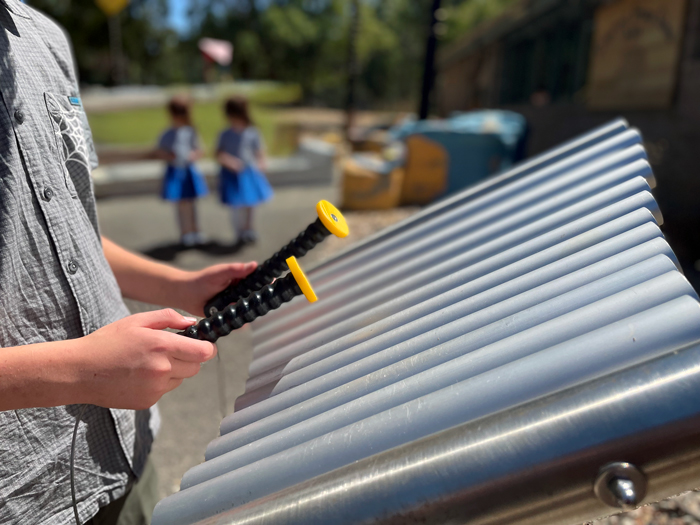
It is worth noting something specific about the scale design of the Wellbeing Instruments Explorer. The Explorer is tuned to the C Major pentatonic scale and this is not an arbitrary design choice. The Composer, designed as a progression from the Explorer, extends this into the full C Major Ionian scale, offering students a natural pathway from open-ended pentatonic play into a broader musical vocabulary.
Research published in Frontiers in Human Neuroscience found that pentatonic sequences were particularly effective at inducing relaxation responses in participants, producing measurable increases in theta and delta brain wave activity associated with calm and restfulness (Conte et al., 2024). The researchers noted that the pentatonic scale’s absence of semitone intervals, the intervals most associated with harmonic tension, creates a quality of indetermination that appears to facilitate relaxation rather than arousal.
In practical terms, this means that a child improvising freely on a pentatonic instrument is unlikely to produce discordant sounds. Every note works with every other note. The result is a naturally calming, affirming experience. One that does not require musical training or instruction to access.
This is consistent with why the pentatonic scale is used exclusively in the Kodály and Orff approaches to early childhood music education, both of which are among the most extensively researched methods in music pedagogy.
Emotional Regulation in Children Who Don't Typically Regulate Well
One of the most important findings in this field concerns children who typically struggle with emotional regulation. Researchers have observed that children who do not demonstrate strong regulation in standard classroom settings are often able to demonstrate it during structured group musical play with peers (Williams, 2018, as cited in Aussie Childcare Network).
This has meaningful implications for inclusive playground design. A musical instrument doesn’t require verbal communication, competitive skill, or rule comprehension to engage with. It offers a low-barrier, sensory-rich entry point that tends to be particularly accessible to children with sensory processing differences, autism, ADHD, and anxiety.
Research on outdoor play and emotional regulation also supports the design logic of outdoor musical instruments specifically. A 2024 study published in Child: Care, Health and Development found that outdoor play supports emotional regulation partly through working memory gains and physiological stress reduction — benefits that are amplified when the outdoor activity has structured sensory engagement rather than being purely unstructured (Lee et al., 2024).

What This Means for School Playground Design
The evidence points toward a clear design principle: children benefit from outdoor spaces that offer rhythmic, sensory, and musical engagement — not as a luxury, but as a neurologically grounded wellbeing intervention.
Schools that integrate musical instruments into their outdoor environments are not simply adding a novelty. They are creating conditions that research suggests will:
- Support the development of executive function and inhibitory control
- Provide accessible regulation opportunities during recess and transition periods
- Offer inclusive engagement for students who may not connect with traditional play structures
- Reduce stress through the neurological effects of pentatonic, rhythmic play
- Foster social cohesion through interpersonal synchrony — the spontaneous coordination that emerges when children play music together
These outcomes align closely with the Australian Student Wellbeing Framework, which identifies safe, inclusive, and engaging school environments as foundational to student learning and development.
A Note on Design
At Wellbeing Instruments, our instruments are developed in collaboration with occupational therapists and designed with these research principles in mind. The pentatonic tuning, the quiet acoustic profile, the absence of competitive structure, and the inclusive physical design reflect an evidence-informed approach to what outdoor musical play can do for children.
If you are considering how a musical instrument might complement your school’s existing wellbeing or sensory spaces, we are happy to discuss what the research suggests about placement, configuration, and student need. [Contact us here.]
References
Conte, S., Russo, V., Ghisolfi, A., & Duma, G. M. (2024). Pentatonic sequences and monaural beats to facilitate relaxation: An EEG study. Frontiers in Human Neuroscience. https://pmc.ncbi.nlm.nih.gov/articles/PMC11056517/
Jamey, K., Foster, N. E. V., Hyde, K. L., & Dalla Bella, S. (2024). Does music training improve inhibition control in children? A systematic review and meta-analysis. Cognition, 252, 105913. https://doi.org/10.1016/j.cognition.2024.105913
Lee, H., et al. (2024). The role of timing and amount of outdoor play in emotional dysregulation in preschool children. Child: Care, Health and Development. https://doi.org/10.1111/cch.70020
Schibli, K., Hirsch, T., Byczynski, G., & D’Angiulli, A. (2023). More evidence that ensemble music training influences children’s neurobehavioral correlates of auditory executive attention. Brain Sciences, 13(5), 783. https://doi.org/10.3390/brainsci13050783
Váradi, J. (2022). A review of the literature on the relationship of music education to the development of socio-emotional learning. Sage Open. https://doi.org/10.1177/21582440211068501
Williams, K. E. (2018). Moving to the beat: Using music, rhythm, and movement to enhance self-regulation in early childhood classrooms. Australasian Journal of Early Childhood, 43(2). https://doi.org/10.23965/AJEC.43.2.06
Williams, K. E., et al. RAMSR (Rhythm and Movement for Self-Regulation) Research Program. Queensland University of Technology. https://research.qut.edu.au/ramsr/
Wellbeing Instruments designs and supplies permanent outdoor musical instruments for schools, early learning centres, and community spaces across Australia. Our instruments are certified to AS 4685 Australian Playground Equipment Standards and developed in collaboration with occupational therapists.